Overview
Many people approach goals through strategy, discipline, and effort. While these are important, there is another factor that often determines whether progress feels natural or difficult: the state of your nervous system.
This article explores how feelings of safety and connection create the conditions for intuition, creativity, and effective action to emerge. Through everyday examples, you’ll discover how small goals and big goals may be achieved in much the same way.
In This Article, You’ll Learn
- Why your nervous system plays a crucial role in goal achievement
- How feelings of safety and connection influence decision-making
- Why intuition often appears when the conditions are right
- A simple way to assess whether a goal is truly aligned
- How small everyday experiences can teach us about achieving bigger goals
I’ve become increasingly interested in a simple question:
What increases the chances of reaching a goal in a sustainable and natural way?
The answer may be simpler than we think.
A while ago, my partner had a birthday coming up. I knew I wanted to make the occasion special, but I had absolutely no idea what to buy her. As the date approached, I could feel the love I had for her and the experience I wanted us to share. Yet despite thinking about it, no clear idea came.
Then, just a few days before her birthday, the answer arrived.
It wasn’t forced. I didn’t figure it out through analysis. The idea simply appeared, and I knew it was right. I bought the gift, and the day turned out beautifully.
I’ve noticed similar experiences many times.
I’ve searched for a book I couldn’t find, only to unexpectedly discover it on a shelf in a small bookstore while travelling.
I’ve felt inspired to take a different running route and ended up bumping into a friend I’d been thinking about, leading to an important conversation.
I’ve followed an intuition to subscribe to a new AI tool, only to receive a complex work assignment the very next day where that tool became invaluable.
I’ve had an inspired idea for a blog post and later received a message from someone saying it arrived at exactly the right time and made a meaningful difference.
These moments might seem unrelated, but I’ve come to believe they share a common foundation.
The Brain’s Checklist
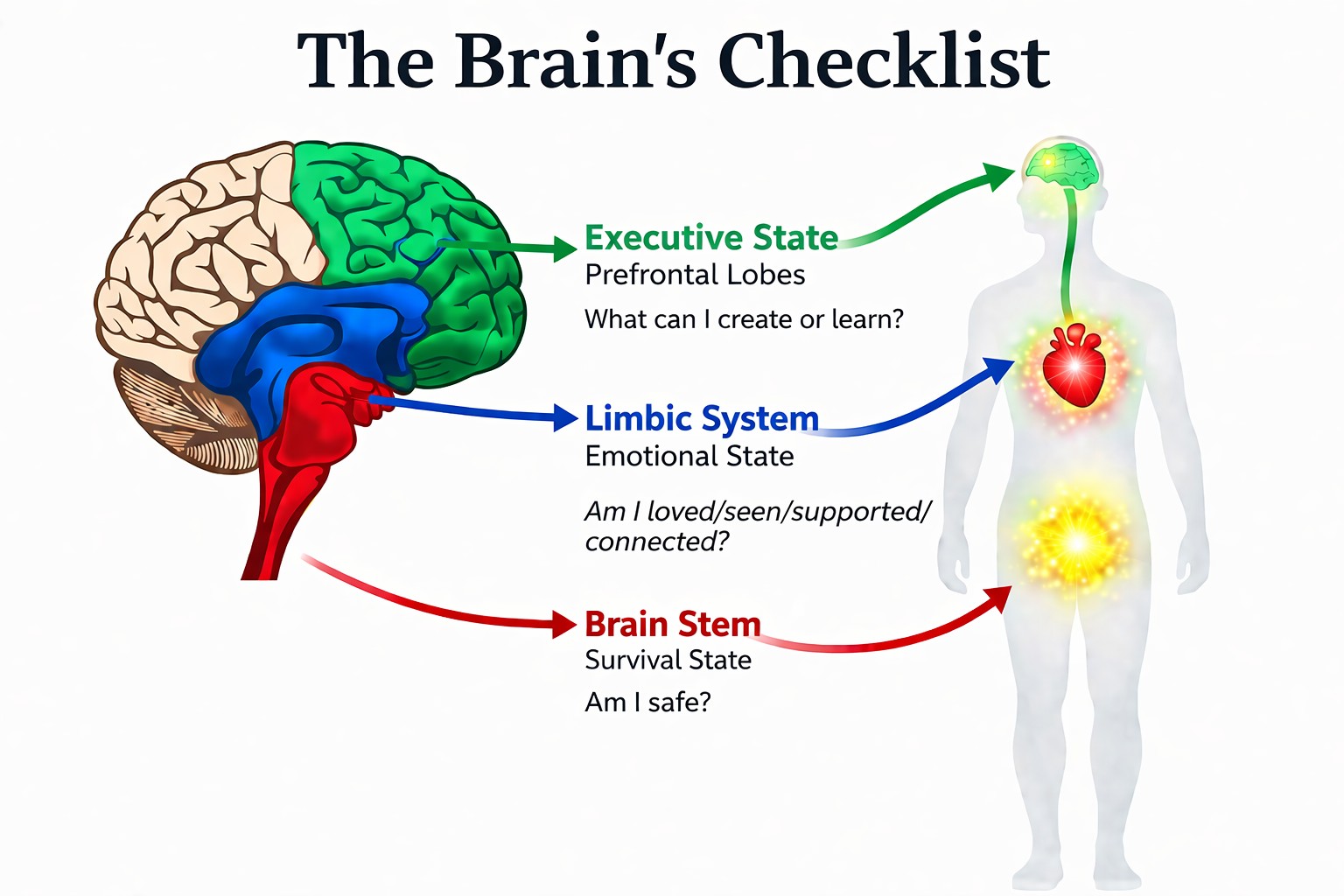
In my coaching work, I often speak about what I call the Brain’s Checklist.
Before creativity and action become available, the nervous system asks two fundamental questions:
Am I safe?
And then:
Am I connected? Am I loved?
Only once these questions are answered positively does the system naturally open to a third question:
What can I create, learn, or do?
When I reflect on the examples above, I notice the same pattern.
Whenever I move towards an outcome that feels true for me, there is usually a sense of safety and connection present.
Without safety, I tend to hesitate, hold back, or feel overwhelmed.
Without connection, the goal often feels empty or meaningless.
But when both are present, something shifts. Ideas emerge. Intuition becomes available. Creativity starts flowing. And most importantly, I trust myself enough to take action on what arises.
We Move Towards What Feels Good
One of the things that fascinates me is how much of our decision-making is driven by feeling rather than thought.
Even when I go for a run, there is always an underlying destination. At some point I am heading home—a place associated with safety, comfort, and connection.
The body knows this.
Perhaps this is true for many of our goals.
We often imagine that progress happens because we think our way there. Yet in my experience, movement happens most naturally when there is a felt sense of safety and love surrounding what we are moving toward.
The thinking mind may help organize the journey, but something deeper is providing the motivation.
A Simple Experiment
Think about a goal you’re currently pursuing.
It could be something significant—a career move, a business venture, a relationship—or something quite ordinary.
Now ask yourself:
- Does this goal feel safe?
- Does it feel connected to what I genuinely care about?
- Does it feel supported?
- Or does it feel pressured, lonely, and driven by fear?
Notice what happens in your body as you reflect.
Then try the same experiment with something very simple.
A cup of coffee.
A warm shower.
Meeting a friend.
Going for a walk.
Notice how you feel before moving toward it, while moving toward it, and once you’ve arrived.
What if we achieve large goals in much the same way?
What if the path to meaningful outcomes begins with creating an embodied experience of safety and connection?
The Invitation
The next time you’re pursuing an important goal, spend less time asking:
“How do I make this happen?”
And spend a little more time asking:
“Does this feel safe?”
“Does this feel connected?”
“Can I allow myself to be supported as I move toward it?”
You may find that when safety and love are present, the next step becomes surprisingly clear.
And from there, progress often unfolds more naturally than you imagined.
love,
Bruce